Delta 8 Benefits: What It's Good For + Common Uses
Delta 8 THC occupies a strange and fascinating middle ground in the cannabis world. For years, consumers felt forced to choose between two extremes.
You either took CBD, which offers subtle wellness support without any intoxication, or you committed to Delta 9 THC, which provides a full-blown psychoactive experience that can sometimes tip over into anxiety or paranoia.
Delta 8 changed that binary conversation completely. It arrived as a functional bridge. It is a compound that offers a distinct "high" but with a ceiling that many users find more manageable than traditional marijuana.
When we discuss the benefits of Delta 8, we have to clarify what we mean by "benefits." This isn't just about the immediate sensation of feeling buzzed. We are talking about why people return to this cannabinoid repeatedly to support their daily lives. We are looking at the specific utility it offers for relaxation, appetite, and physical tension.
It is crucial to understand that Delta 8, scientifically known as delta-8-tetrahydrocannabinol, is indeed intoxicating. If you are looking for a purely non-psychoactive experience, you are in the wrong place; you should likely explore broad-spectrum CBD instead. However, if you are looking for something that sits comfortably between the silence of CBD and the noise of Delta 9, Delta 8 might be the tool you need.

Visualizing the middle ground: Controlled relaxation between silence and noise.
What Is Delta 8 Good For?
If you ask the average user what Delta 8 is used for, the answer usually revolves around "functional relaxation." It has carved out a niche for people who enjoy the decompression of cannabis but cannot tolerate the mental fog or racing heart that often accompanies stronger THC products.
Practically speaking, Delta 8 is most commonly sought out for deep relaxation that doesn't incapacitate the user. It is widely used to support appetite, often more intensely than its chemical cousins. Users also turn to it for physical comfort, noting a heavy "body load" that soothes tension without necessarily locking them to the couch for the entire day.
Sleep support is another massive category. While it isn't a sedative in the pharmaceutical sense, the psychotropic effects often drift naturally into drowsiness as they wear off.
This cannabinoid is for the "Goldilocks" user. It is for the person who finds CBD too subtle to notice but finds high-potency Delta 9 products overwhelming or anxiety-inducing.
Benefits of Delta 8
We need to break down these broad categories into specifics. While the list of potential benefits is promising, it is important to distinguish between what clinical science has proven and what millions of users report anecdotally.
Stress and Mental Calm
The most cited benefit of Delta 8 is its ability to facilitate a sense of calm. Users often describe the experience as "weightless." Unlike Delta 9, which can stimulate the mind into a frenzy of overthinking, Delta 8 tends to keep the experience grounded.
You feel the psychoactive shift, yet you often retain a clearer headspace. This makes it a popular choice for evening decompression after a high-stress workday.
The evidence here is largely anecdotal and based on the compound’s binding affinity to the CB1 receptors. It binds less efficiently than Delta 9, which is theorized to be the reason for the reduced anxiety risk. Vapes are the preferred product form here for immediate relief, while gummies offer a longer, slower onset for sustained relaxation.
Appetite Stimulation
If there is one area where Delta 8 might actually outperform Delta 9, it is appetite stimulation. The "munchies" associated with Delta 8 are legendary among users. This is not just about wanting a snack; it is often a profound increase in the drive to eat.
This makes the compound particularly interesting for those who struggle with caloric intake due to other issues. Animal studies dating back to the 1990s and earlier have suggested that Delta 8 drove food intake in mice significantly, sometimes even more than Delta 9, with fewer side effects. For this goal, edibles are generally the best choice as the digestive processing of the cannabinoid seems to synergize well with the desire to eat.
Physical Comfort and Tension
Delta 8 is frequently described as having a "heavy" physical presence. Users report a sensation of physical relaxation that permeates the muscles. This makes it a go-to option for those dealing with post-workout recovery or general physical discomfort.
Because the head-high is clearer, users feel they can address physical tension without becoming mentally useless. The highest quality evidence we have for this comes from historical studies on nausea and minor pain pathways in animal models, though human clinical trials for chronic pain specifically using Delta 8 are sparse.
Tinctures and balms are less common here; most users prefer gummies to get that full-body systemic effect.

Late afternoon physical relief and tension release.
Sleep Support
While Delta 8 is not marketed strictly as a sleeping pill, the trajectory of the experience often leads there. The "comedown" from a Delta 8 high is rarely abrupt. It usually fades into a lethargic, cozy sensation that makes falling asleep easier.
It quiets the internal monologue that keeps many people awake. This is widely reported in user surveys and aligns with the general sedative properties of THC isomers.
For sleep, timing is everything. A gummy taken thirty minutes before bed might not hit until you are already staring at the ceiling; taking it two hours before your target sleep time is the smarter play.
How to Get Better Results
Achieving these benefits isn't just about popping a gummy and hoping for the best. The method matters. Consistency is less of a factor with Delta 8 than it is with CBD. You don't need to build it up in your system for weeks to feel it. You will feel it immediately.
However, you do need to manage your tolerance. The body adapts to Delta 8 faster than almost any other cannabinoid. If you use it daily, you will find the benefits diminishing rapidly, forcing you to take higher doses.
To maintain the benefits, use Delta 8 sporadically or cycle your usage. If you are using it for sleep, try to skip a night here and there.
Furthermore, combining cannabinoids can alter the outcome. Adding CBD to your Delta 8 dose can smooth out the edges even further, reducing the intoxicating "peak" while prolonging the body relaxation. This is often called the "entourage effect," and responsible experimentation here can help you dial in the exact feeling you want.
Delta 8 Benefits Chart
When you are trying to decide if this cannabinoid fits your lifestyle, it helps to see the data laid out plainly. This chart breaks down the common goals and the reality of using Delta 8 to achieve them.
| Benefit Goal | What People Notice | Best Forms | Timing | Evidence Level | Notes |
|---|---|---|---|---|---|
| Relaxation | Clear-headed calm, reduced racing thoughts. | Vapes, Tinctures | Vapes: 5-15 min; Tinctures: 30-60 min. | Moderate (Animal/Anecdotal) | Lower risk of paranoia than Delta 9. |
| Appetite | Intense hunger ("munchies"). | Gummies, Edibles | 1-2 hours (peak effects). | Strong (Preclinical/Animal) | Can lead to overeating; plan meals ahead. |
| Sleep | Drowsiness, body heaviness. | Gummies, Capsules | Take 2 hours before bed. | Mostly Anecdotal | Sedation often occurs on the comedown. |
| Physical Comfort | Muscle relief, "heavy" limbs. | Gummies, Topicals | Edibles last 4-6 hours. | Moderate (Preclinical) | Often described as a "body high." |
| Nausea | Stomach settling. | Vapes (for speed) | Instant. | Strong (Historical Clinical) | Famously used in pediatric studies (1995). |
What the Science Actually Supports
We must be careful to separate marketing hype from scientific reality. The cannabis industry moves faster than clinical research, meaning much of what we "know" comes from user reports rather than double-blind placebo studies.
The "evidence ladder" for Delta 8 is unique. We have a significant amount of preclinical evidence, meaning studies on rats and mice, regarding appetite and pain receptors.
We also have a famous snippet of human clinical evidence from 1995. Researchers in Jerusalem successfully administered Delta 8 to children undergoing chemotherapy to stop vomiting, noting a 100% success rate with negligible side effects.
However, beyond that specific study, most modern claims rely on human observational data. This is essentially surveys of thousands of users. These surveys consistently report lower anxiety and paranoia compared to Delta 9, but these are subjective experiences rather than lab results.
Beware of any product promising to "cure" anxiety or insomnia. The science supports Delta 8 as a tool for symptom management, not a cure-all.
Delta 8 vs Other Cannabinoids
Understanding where Delta 8 fits in the family tree helps you choose the right tool.
Delta 8 vs. CBD
These are for entirely different goals. CBD is non-intoxicating and works in the background to reduce inflammation and anxiety over time. Delta 8 is front-and-center. It gets you high and offers immediate, tangible shifts in perception and body feel. If you need to drive a car or operate machinery, stick to CBD.
Delta 8 vs. Delta 9 THC
This is the most common comparison. Delta 8 is often called "diet weed," but a better description is "clarified weed." Delta 9 is more potent and more psychedelic, but it carries a higher "mental load" that can lead to anxiety.
Delta 8 is roughly 50% to 70% as potent as Delta 9. It provides a similar euphoric feeling but with a much lower chance of panic. It is the "middle lane" option.
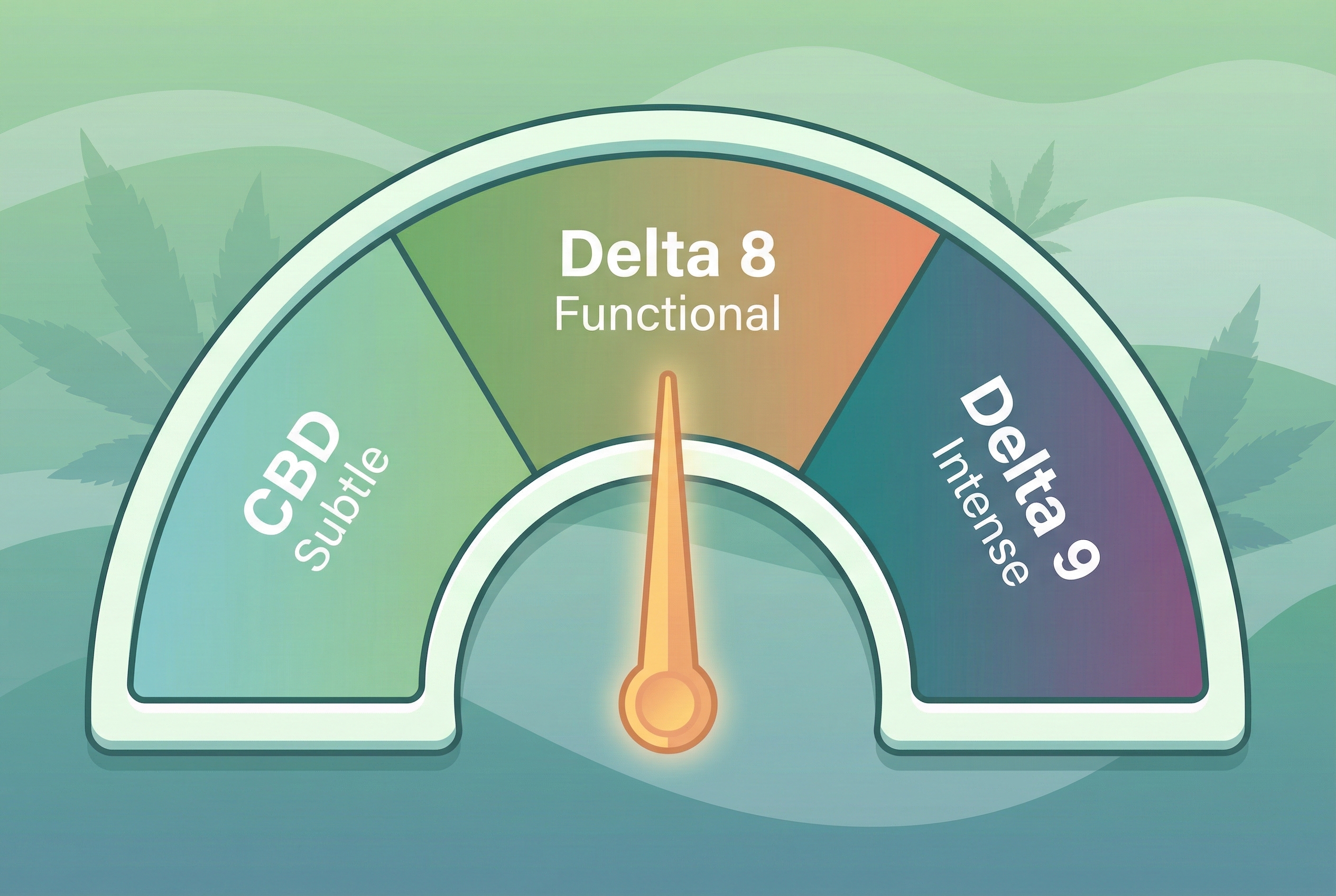
The "Middle Lane": Bridging subtle CBD and intense Delta 9.
Benefits: Key Takeaways
Delta 8 has cemented its place in the market because it solves a specific problem. It offers the benefits of THC without the baggage. It is primarily used for relaxation, appetite stimulation, and sleep support.
- It is not a productivity booster as the body high can make you lethargic.
- It is ideal for those who want to feel the effects of cannabis but are sensitive to the anxiety caused by traditional marijuana.
- Unlike CBD, you feel this instantly, but tolerance builds fast. Use it responsibly to keep the magic alive.
Frequently Asked Questions
What is Delta 8 used for?
People primarily use Delta 8 as a recreational relaxant that feels safer and more controlled than standard marijuana. It is used to unwind after work, stimulate a poor appetite, or help the body settle down before sleep.
What is Delta 8 good for?
Practically, it is good for "taking the edge off." It serves as a bridge for people who need stronger relief than CBD provides for physical tension or stress but who do not want the intense impairment of Delta 9.
What does Delta 8 do for you?
It binds to the CB1 receptors in your brain, similar to regular THC, but with a weaker attachment. This results in a psychoactive "high" that feels uplifting and soothing. For many, it creates a sense of heaviness in the limbs and a quieting of mental chatter.
How long does it take to notice benefits?
This depends entirely on the form. If you vape Delta 8, you will feel the benefits within 5 to 15 minutes. If you take a gummy or edible, you are at the mercy of your digestion. It can take anywhere from 45 minutes to 2 hours to notice the effects.
Can you take Delta 8 every day?
You can, but it is not recommended if you want to maintain potency. Your body builds a tolerance to Delta 8 very quickly. Daily use often leads to diminishing returns, meaning you have to take more to feel the same benefits.